
Autumn 2026
Introduce the competition to students and consider whether course projects, research work or independent projects could be developed further.
Teachers play an important role in encouraging students to develop research projects, narrow their questions, prepare presentations and see that their own ideas can become strong projects.
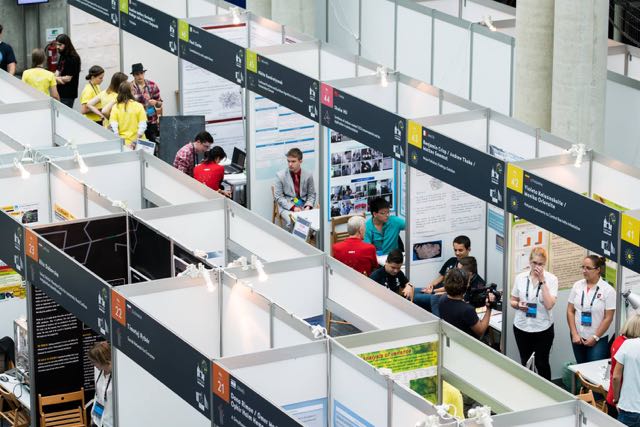
Students may have strong ideas but often need help narrowing them. A teacher can help them choose a clear research question, find a suitable method and prepare a presentation that explains the work clearly.
Students can begin developing projects during autumn 2026. Applications are planned to open in December, with the Ungt vísindafólk national competition taking place in spring 2027.
Introduce the competition to students and consider whether course projects, research work or independent projects could be developed further.
Applications are planned to open. Further information about the application process, rules and practical arrangements will be published before applications open.
The national competition will be held, and selected participants may have opportunities to continue to international participation.
Tell students about Ungt vísindafólk and show them that projects can come from many fields, not only traditional natural sciences.
Help students turn a large idea into a clear question that can be investigated, tested or explained.
Give students feedback on their question, method, use of sources, results and presentation.
Course projects, final assignments, innovation projects, research essays, design projects or experiments can be a good starting point for participation in Ungt vísindafólk.
A project from a course can become a competition project if it is developed further and presented clearly.
A prototype, technical solution or design idea can work well if students can show testing and improvement.
An essay, survey, data analysis or experiment can become a strong project with a clear question and method.
Ask students what they want to understand, test, measure, design or change.
Help them choose a question that is small enough to work on well.
Discuss whether the project needs data, an experiment, sources, a survey, interviews, programming or a prototype.
Let students practise explaining the project orally and answering simple questions about their work.
Experiments, measurements, biology, chemistry, physics, geology, environment or climate.
Attitudes, behaviour, school issues, rights, social media, democracy, culture or everyday life.
Programming, artificial intelligence, data analysis, design, engineering, prototypes or solutions to real problems.
The jury will not only look at the final result. It will want to understand what the students investigated, how they worked, how they interpret their results and what they learned from the process.
Is it clear what the student wants to investigate or develop?
Can the student explain how the project was carried out?
Can the student describe what they found and what could be done next?
The student should be able to explain the project in a few sentences without overly complicated wording.
It should be clear how the student gathered information, tested a solution or reached a result.
If the project builds on previous research, data, images, ideas or code, this should be explained.
The student should be able to describe the beginning, process, results and next steps in their own words.